
Custom vs Semi-Custom Website: Which Is Right for Your Home Service Business?
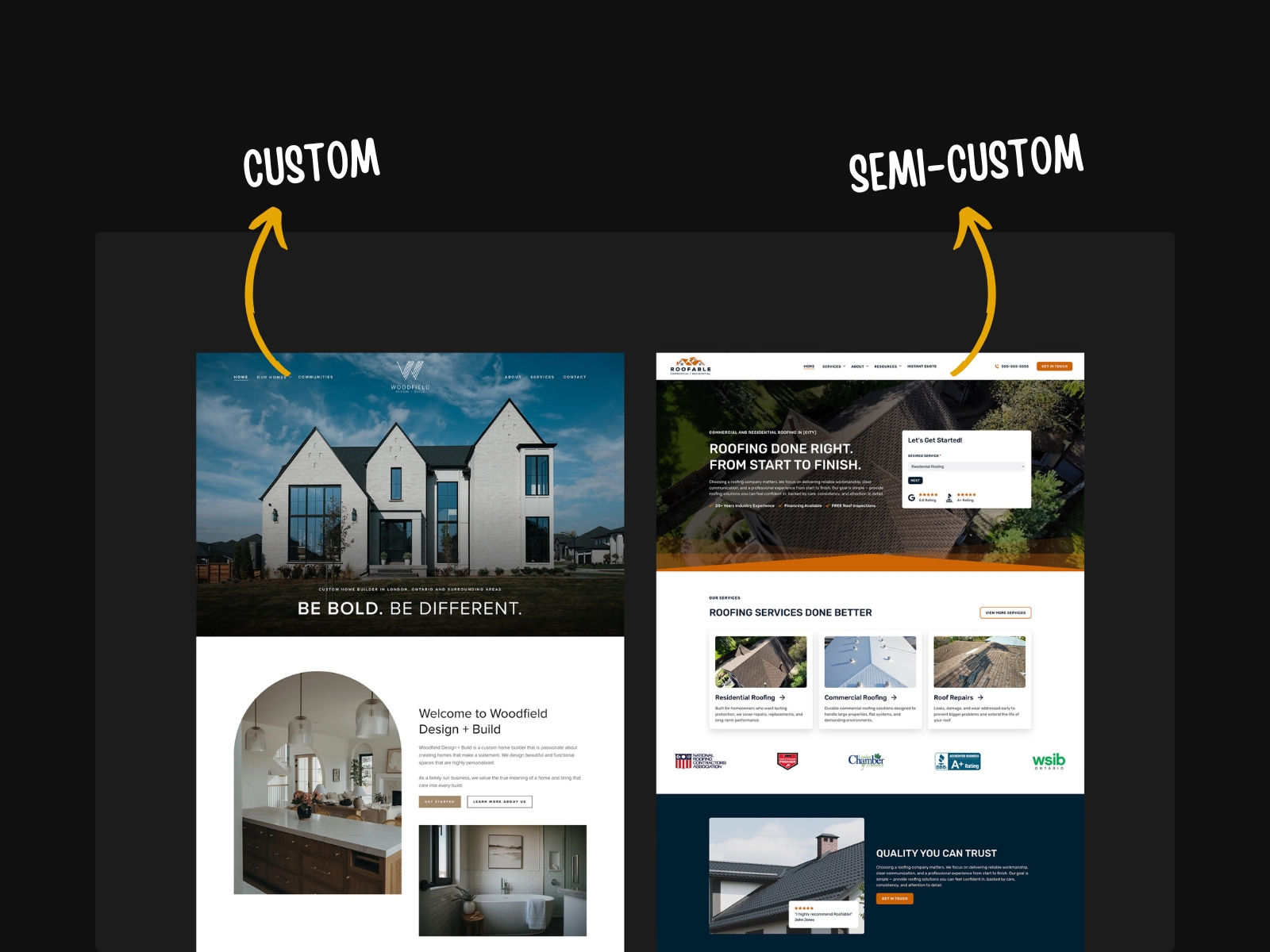
If you run a home service business and you’re investing in a new website, you’ll likely hear two options:
- Custom website
- Semi-custom website
And somewhere in that conversation, someone will say:
“Custom is always better.”
That’s not necessarily true.
The better question isn’t which one performs better in theory.
It’s:
Which one makes the most sense for your stage, goals, budget, and growth plans?
For some home service businesses, a fully custom website is the right move.
For many others, a strategically built semi-custom website is the smarter investment — especially in the early and mid stages of growth.
This guide will help you decide.
We’ll break down:
- The real difference between custom and semi-custom
- What actually impacts website performance
- The pros and tradeoffs of each
- Which type of company each fits best
- How to evaluate based on your revenue stage and goals
First: What Actually Determines Website Performance?
Before comparing custom vs semi-custom websites, we need to clarify something important.
Performance doesn’t come from originality.
It comes from:
- Clear messaging
- Strong service segmentation
- Local SEO structure
- Trust placement
- Mobile optimization
- Page speed
- Repeated calls-to-action
- Clean user flow
A beautifully designed custom website with weak structure will underperform.
A strategically structured semi-custom website with clear conversion flow can dominate.
The debate is less about “custom vs template” — and more about strategy vs decoration.
Keep that in mind as you evaluate your options.
What Is a Custom Website?
A custom website is built from scratch.
Design, layout, and structure are created specifically for your company — not adapted from an existing framework.
This typically includes:
- Unique UI design
- Custom UX decisions
- Fully tailored page structures
- Potentially custom development features
You’re not starting from a pre-built system.
You’re starting from a blank canvas.
Let’s remove the hype and focus on what fits your business.
Pros of a Custom Website
1. Complete Design Freedom
You’re not limited by framework constraints. Layouts, animations, integrations — everything can be built uniquely.
2. Stronger Brand Differentiation
If you’re building a regional or premium brand, custom design can elevate perception and support positioning.
3. Complex Architecture Support
If you operate multiple divisions (residential + commercial), serve multiple regions, or require specialized functionality, custom structure may offer more flexibility.
4. Long-Term Scalability
Custom builds can be designed with long-term growth in mind, especially for companies preparing to expand aggressively.
Cons of a Custom Website
1. Higher Investment
Custom builds require more design hours, more development time, and more revision rounds.
2. Longer Timeline
Strategy → design → revisions → development → QA → launch.
It takes time.
3. Over-Engineering Risk
Many contractors invest in custom before they actually need it — paying for complexity that doesn’t increase revenue.
What Is a Semi-Custom Website?
A semi-custom website uses a proven structural framework designed specifically for a certain industry — then customizes branding, content, messaging, and configuration within that framework.
It is not:
- A $59 theme
- A generic DIY template
- A drag-and-drop builder mess
A strong semi-custom website should still include:
- Conversion-focused layout
- SEO-ready architecture
- Individual service pages
- Custom copy
- Custom imagery
- Brand integration
- Performance optimization
The key difference is efficiency.
The structure has already been tested and refined for home service businesses.
You’re customizing within a system instead of building one from scratch.
Pros of a Semi-Custom Website
1. Faster Launch
Because the core framework is built, you eliminate months of design iterations.
2. Lower Investment
You’re not paying to reinvent structure.
3. Proven Conversion Flow
Instead of experimenting with layout theory, you’re using a structure built around how homeowners search and decide.
4. Capital Efficiency
You can allocate more budget toward:
- SEO
- Paid ads
- Automation
- Hiring
Which often drives faster ROI than over-investing in design originality.
Cons of a Semi-Custom Website
1. Structural Boundaries
You operate within a framework. If you need highly unique features or complex integrations, flexibility may be limited.
2. Not Ideal for Enterprise-Level Brands
Large regional or multi-state operators may eventually outgrow framework-based systems.
So… Which One Is Right for You?
Now let’s get practical.
The decision should be based on your business stage — not ego or assumptions.
A Semi-Custom Website Is Likely Right for You If:
✔ You’re Under $3M in Revenue
At this stage, performance and lead generation matter more than extreme design differentiation.
✔ You’re Replacing an Outdated or Bloated Website
If your current site is slow, clunky, or built in a heavy page builder, you probably need clean structure — not full custom.
✔ Your Primary Goal Is Lead Generation
If you want:
- More calls
- More form submissions
- Better local visibility
A strategically built semi-custom website can accomplish that efficiently.
✔ You Want to Launch Quickly
If timing matters due to rebranding or SEO efforts, speed can be a strategic advantage.
A Custom Website May Be Right for You If:
✔ You’re Scaling Aggressively
If you’re building toward $5M–$10M+ revenue, positioning and differentiation may become more important.
✔ You Operate in Highly Competitive Metro Markets
Brand perception can impact close rates in saturated markets.
✔ You Have Complex Service Structures
Commercial divisions, multiple regions, advanced integrations, or specialty service lines may justify custom architecture.
✔ You’re Preparing for Enterprise Growth or Acquisition
Long-term flexibility and infrastructure control may warrant higher investment.
What Actually Moves the Needle (Regardless of Type)
Whether custom or semi-custom, these elements determine success:
- Clear, location-specific headlines
- Individual service pages
- Strong trust signals above the fold
- Real project photography
- Process explanation sections
- Review integration
- Financing visibility
- Fast load speed
- Mobile-first UX
- Strong internal linking
If these aren’t present, the type of build doesn’t matter.
Structure drives performance.
The Real Decision Framework
Instead of asking:
“Which performs better?”
Ask:
- What stage is our business in?
- What is our marketing budget?
- Where will capital generate the highest ROI?
- Do we need complexity — or clarity?
- Is speed to launch important right now?
For many growing home service businesses, a strategically built semi-custom website offers the best balance of cost, speed, and performance.
For more mature, brand-driven operators, custom can provide long-term leverage.
The right choice depends on where you are today — and where you’re trying to go.
How We Approach It at Tweakable
At Tweakable, we build both:
- Semi-custom websites built specifically for home service industries
- Fully custom websites designed around long-term growth and positioning
We don’t push one over the other.
We evaluate your:
- Revenue stage
- Market competitiveness
- Growth goals
- Budget allocation strategy
Then recommend what makes the most strategic sense.
Every site we build — regardless of type — prioritizes:
- Conversion clarity
- SEO alignment
- Clean performance
- Scalable architecture
If you’re unsure which direction makes sense for your business, we can help you evaluate it objectively.
Learn more about our web design and development services.
Or request a consultation and we’ll help you determine which structure is right for your stage of growth.
